
What to look for in an IVF laboratory
Understand embryology staffing, identification and traceability, quality management, incubator monitoring, backup systems and result communication.
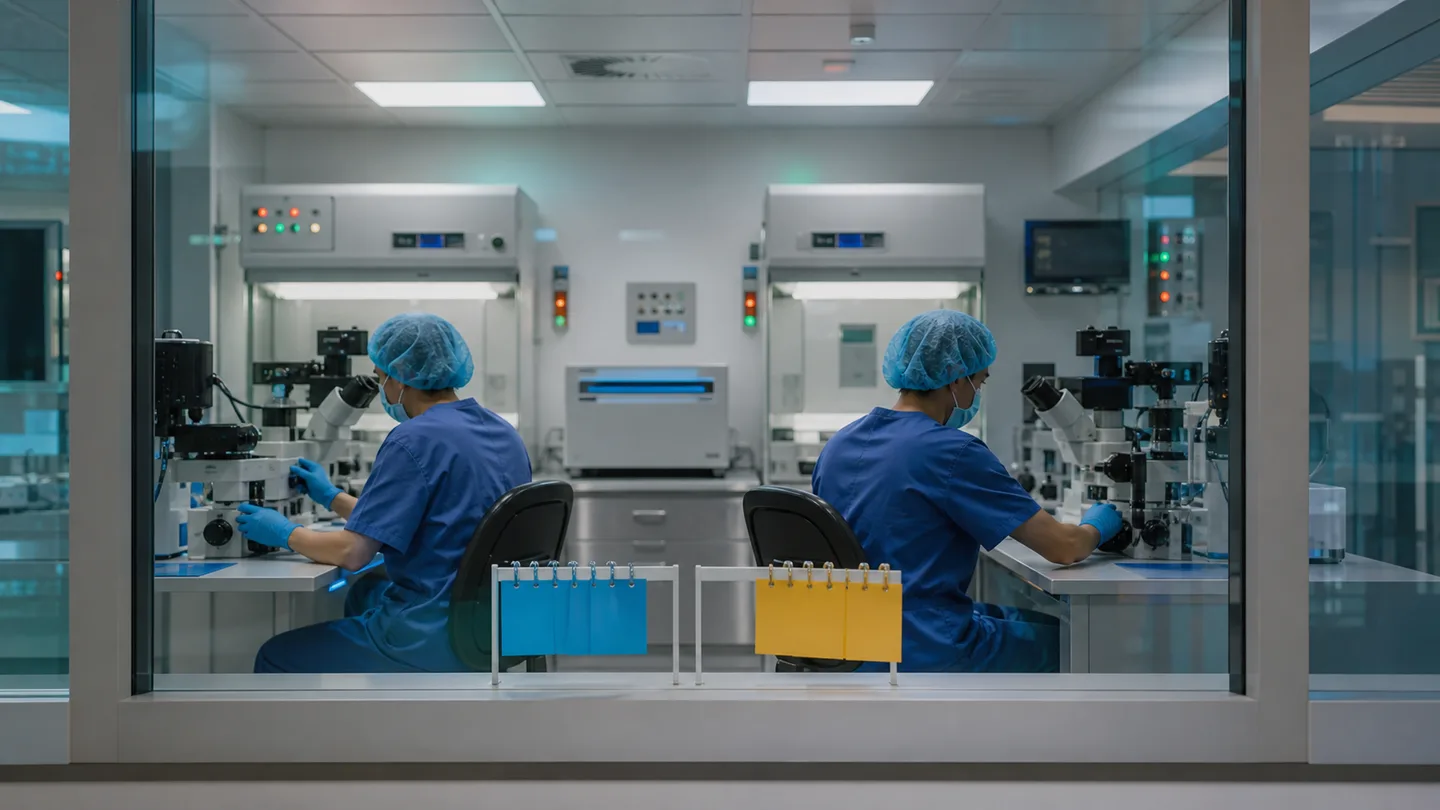
Knowing what to look for in an IVF laboratory is a reasonable patient concern; it does not mean demanding physical access to a controlled workspace. Embryos develop in a highly regulated environment, and quality cannot be judged by how new the equipment looks.
ESHRE and ASRM guidance emphasises trained staff, written procedures, patient and specimen identification, traceability, equipment monitoring, quality management and emergency plans. A clinic should be able to explain these safeguards in plain language without disclosing confidential technical details.
People, procedures and traceability
Ask about the laboratory director’s and embryologists’ relevant training, ongoing competency assessment and written rules for critical procedures. A double-witness process or validated electronic system should protect the link between patient identity and eggs, sperm or embryos at every stage.
Recording the fertilisation, embryo development, transfer, freezing and storage status of each oocyte supports decisions and audit. Patients should know when updates are given, who communicates them and how laboratory terms and limitations will be explained.
Environment, equipment and emergency readiness
Incubator temperature and gases, laboratory air, cryogenic storage tanks and critical devices require ongoing monitoring. Calibration, maintenance, out-of-hours alarm response and review of laboratory performance indicators should follow a documented quality system.
Ask about backup procedures for power loss, equipment failure, tank alarms, fire and data loss. A concrete plan that reduces risk and learns from incidents is more reassuring than an unsupported claim that nothing can ever go wrong.
A quality system should be explainable even when it is not visible
A robust laboratory uses two-step identification and witnessing, continuous incubator temperature and gas monitoring, equipment-failure procedures and backup power. Without disclosing confidential information, the embryology team should be able to describe how outcomes are reviewed, incidents investigated and staff competence maintained.
Discuss laboratory performance through relevant measures such as fertilisation, blastocyst development, freeze–thaw survival and policies that reduce multiple pregnancy, not a general claim of excellence. These are service indicators, not guarantees for one embryo, and need clinical context. Accreditation is useful but does not replace dependable daily processes.
Frequently asked questions
Do I need a personal tour of the laboratory?
Access to a clean controlled area may be restricted. More important is a specific, understandable explanation of staffing, traceability, quality monitoring and backup systems.
Can a patient visit the embryology laboratory?
Access may be restricted for contamination control, privacy and workflow. Ask instead for a structured explanation of leadership, witnessing, backup systems, quality monitoring and communication, with a virtual overview if the clinic offers one.
Bring your embryology questions to an Övlad Payı consultation and let our team explain the laboratory pathway clearly in relation to your proposed plan.
Trusted sources
This article is for patient education and does not replace individual medical advice.