IVF fertilisation and embryo culture: days in the laboratory
Understand fertilisation, cell division, blastocyst development and what embryo updates mean after egg retrieval in clear language.
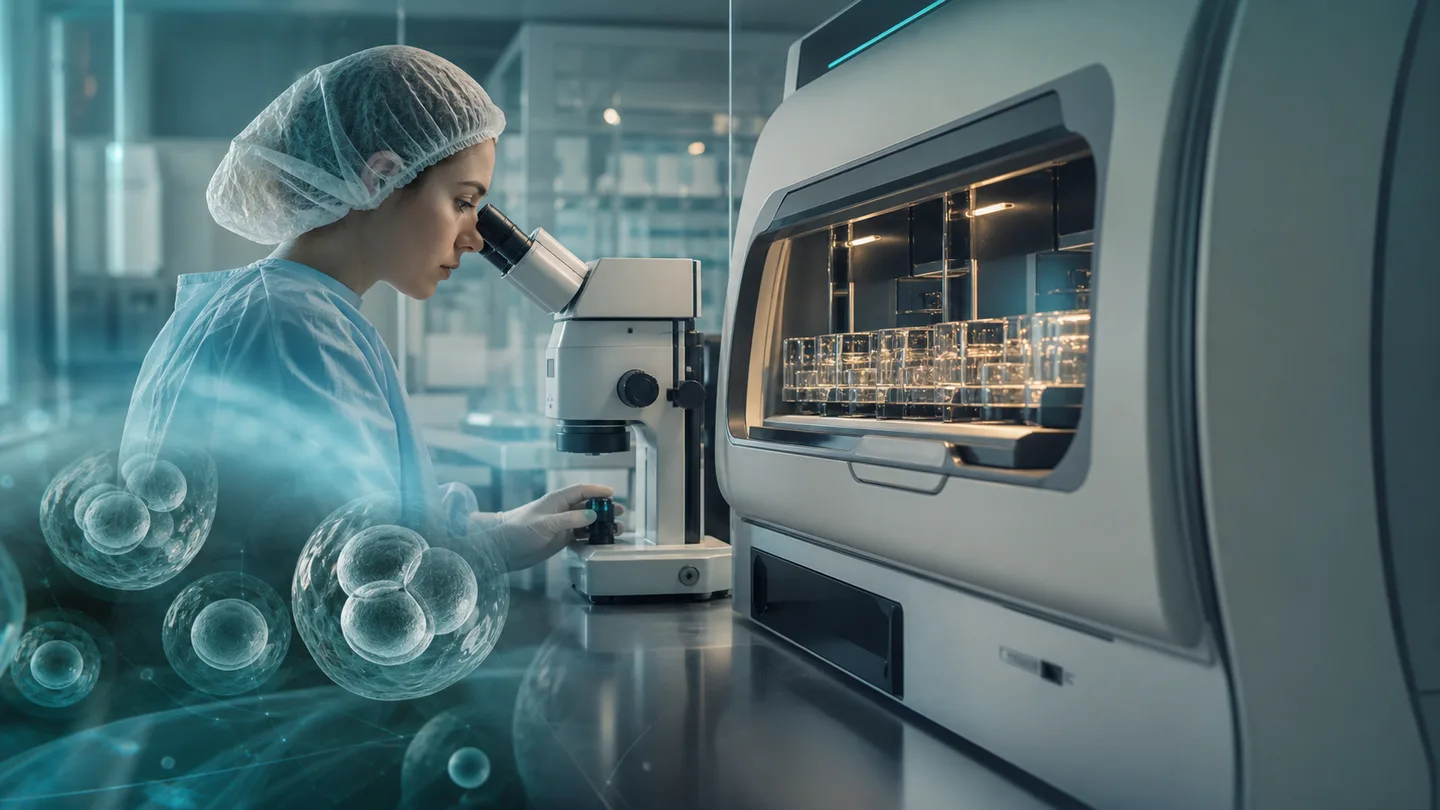
IVF fertilisation and embryo culture begin immediately after egg retrieval. The laboratory first checks egg maturity, sperm preparation and the planned insemination method. Embryos are then kept in incubators with tightly controlled temperature, gas and moisture and are assessed only at appropriate times.
This stage can bring many numbers and unfamiliar terms. Counts of collected, mature, fertilised, dividing and blastocyst-stage embryos naturally reduce along the pathway; a decrease does not by itself mean a mistake. Compare results with your own starting numbers and the laboratory explanation rather than another person’s cycle.
Fertilisation: conventional IVF and ICSI
In conventional IVF, many prepared sperm are placed around each egg and one is expected to enter. With ICSI, an embryologist injects one selected sperm into a mature egg. ICSI may be used for male-factor infertility, a previous fertilisation problem and specific laboratory indications, but it does not automatically improve outcomes for every patient.
Fertilisation is commonly checked the following day by looking for two pronuclei. Not every mature egg fertilises, and occasionally an abnormal pronuclear pattern is seen. The laboratory continues observing embryos that meet its criteria for normal development and records where counts change.
- Ask for the mature egg count separately
- Understand why IVF or ICSI was selected
- Learn the laboratory definition of normal fertilisation
From cell division to blastocyst
After fertilisation, cells divide. Around day three, reports may describe cell number, symmetry and fragmentation. By days five and six, embryos reaching the blastocyst stage can be assessed for the inner cell mass, which contributes to the fetus, and the outer layer that contributes to the placenta.
Embryos are not expected to develop at exactly the same speed. Slower development does not always mean arrest; the laboratory follows its validated observation and freezing criteria. An embryo grade describes appearance. It is neither a guarantee of a healthy baby nor a complete genetic test.
- Day-three cleavage observations
- Day-five or day-six blastocyst development
- A decision to transfer, freeze or continue observation
Interpreting updates and asking useful questions
Know in advance when the clinic will update you; taking embryos out for unnecessary hourly checks may be inappropriate. Ask the report to follow the pathway from eggs collected to mature eggs, normal fertilisation, continuing embryos and the blastocysts transferred or frozen.
A grade or image cannot predict with certainty that one embryo will implant. Age, day of development, laboratory information, the uterine environment and other factors act together. If PGT is planned, biopsy, freezing, limitations of the result and the later transfer process need a separate explanation.
- Receive the update schedule before collection
- Ask for counts at every transition
- Treat grading as selection information, not a promise
Frequently asked questions
Why do not all fertilised eggs become blastocysts?
Natural biological selection and developmental arrest occur during early embryo growth. Controlled laboratory conditions support development but cannot change the potential of every cell.
Does a high-grade embryo guarantee pregnancy?
No. Grading describes microscopic appearance and supports selection, but does not guarantee implantation or live birth. A personal estimate considers several clinical factors.
Ask the Övlad Payı laboratory to explain your IVF fertilisation and embryo culture report as a sequence from starting eggs to transfer or freezing. A clear pathway makes the numbers easier to understand calmly.
Trusted sources
This article is for patient education and does not replace individual medical advice.