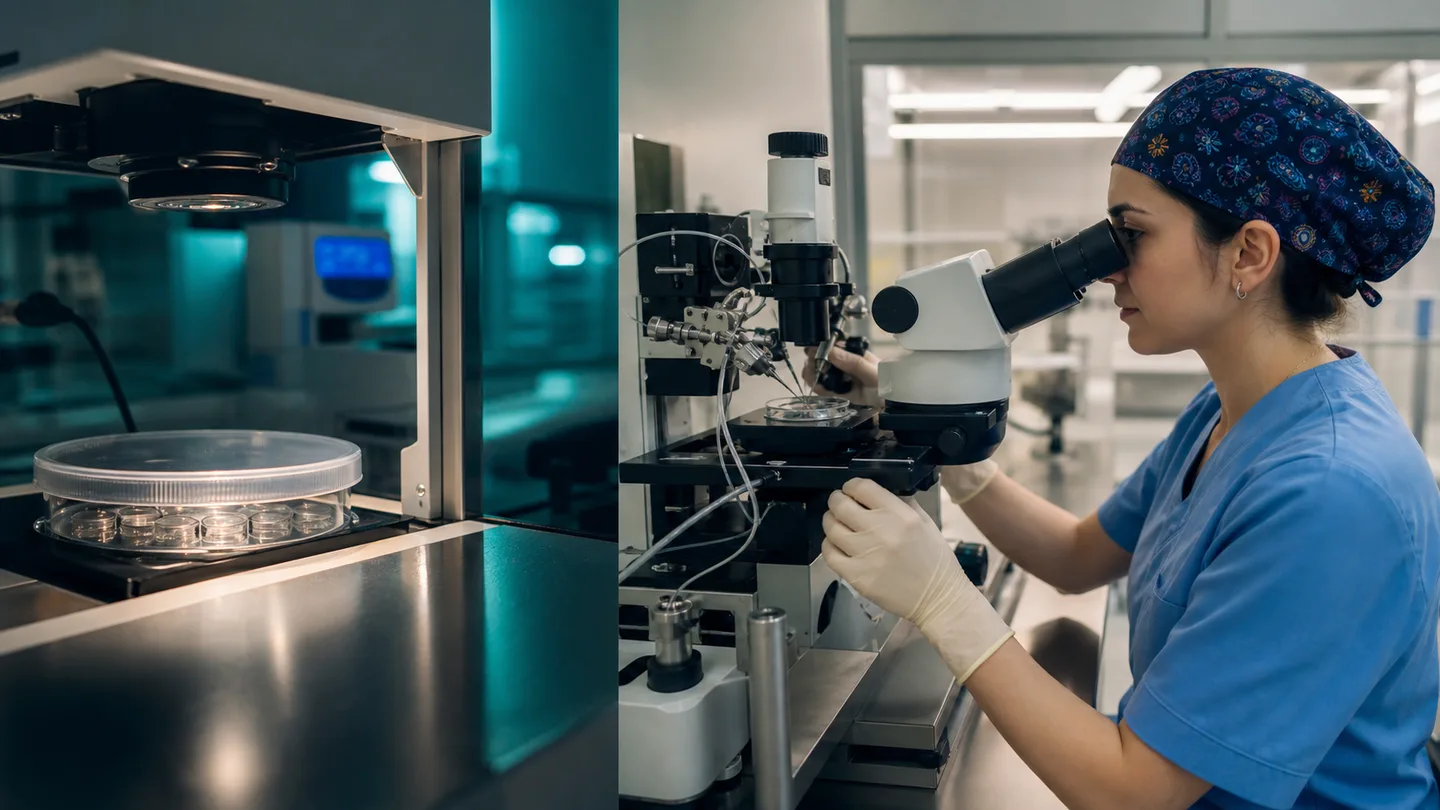
Blastocyst culture: waiting until days five and six
Understand why embryos may be cultured to blastocyst, how it can support selection and the possibility that no embryo remains for transfer.

Blastocyst culture means growing fertilised embryos in the laboratory until day five and sometimes day six. At this stage, an embryo forms a fluid-filled cavity, inner cell mass and trophectoderm. The laboratory follows developmental pace and morphology to identify embryos suitable for transfer or freezing.
Longer culture is not automatically an advantage for every patient. Its benefit is more information for choosing among embryos that continue to develop; its trade-off is that some cycles have no embryo reaching a usable blastocyst in the laboratory. The decision should consider starting embryo number, age, history and the laboratory’s own outcomes.
Why culture embryos until day five?
At early cleavage stage, several embryos can appear similar. Further culture shows which continue through compaction and blastocyst formation. This additional information may help establish transfer priority, especially when a single embryo transfer is planned.
The blastocyst stage is closer to the time an embryo would normally reach the uterus, and suitable embryos can be vitrified in a strong freezing programme. Culture does not repair chromosomes or turn a poor-potential embryo into a strong one. The laboratory provides controlled conditions and observation rather than changing inherent potential.
- Additional information about continued development
- Relative selection for single embryo transfer
- A suitable stage for blastocyst vitrification
The chance of having no embryo to transfer
Some embryos that look transferable on day two or three stop before becoming a blastocyst in culture. It is impossible to know with certainty whether each would have continued inside the uterus. When only one or two embryos are available, the choice of extended culture needs particularly careful discussion.
An earlier transfer is not automatically superior either. The team should discuss its laboratory outcomes by age and embryo number, the patient’s previous cycle and access to freezing. A general statement that “blastocysts are better” cannot replace an individual risk–benefit conversation.
- Consider the starting number of embryos
- Discuss an earlier transfer as a separate option
- Ask for laboratory results relevant to your group
How day-five and day-six decisions are made
A suitably expanded blastocyst may be selected for transfer or freezing on day five. Slower embryos may remain under observation until day six. Every laboratory has an observation schedule, grading system and minimum freezing criteria, so day and grade need to be interpreted together.
The final report should account for fertilised embryos, continued development, transferred and frozen blastocysts and embryos that arrested. Grading supports selection but does not predict a baby. Also understand storage duration, consent and future-use arrangements for embryos remaining frozen.
- Day-five transfer or vitrification decision
- Appropriate observation through day six
- Documentation of the final status of every embryo
Frequently asked questions
Is blastocyst transfer always better than day-three transfer?
No. Average outcomes may differ in selected groups, but the personal decision depends on embryo number, age, history and laboratory performance.
Is the cycle over if there is no blastocyst on day five?
Not necessarily. Some embryos reach a suitable blastocyst stage on day six. Ask how long the laboratory observes and which minimum criteria it uses.
Discuss blastocyst culture with the Övlad Payı embryologist using your starting embryo count, the earlier-transfer alternative and the laboratory’s day-five and day-six criteria. A personal risk–benefit plan is more useful than a general slogan.
Trusted sources
This article is for patient education and does not replace individual medical advice.